Axolotls in Xochimilco: what the numbers actually say
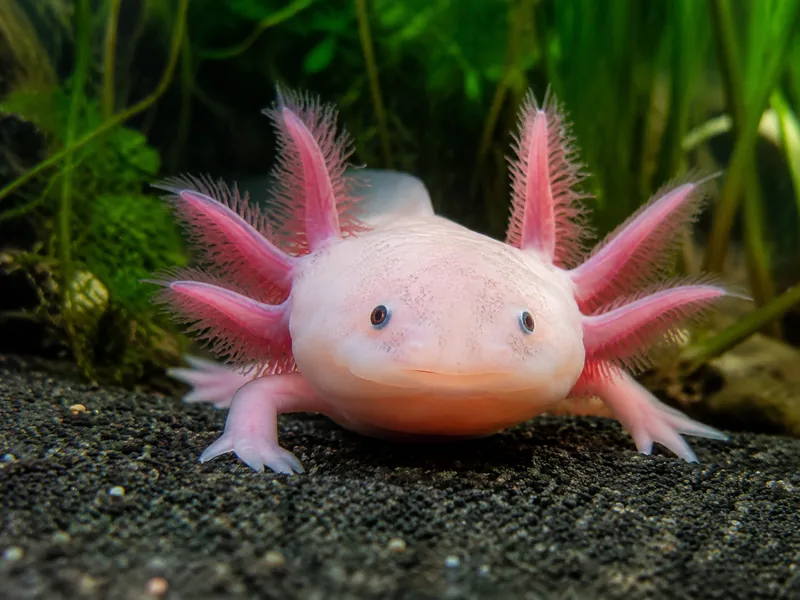
The collapse, as it was measured
The density series below is the work of Dr Luis Zambrano and colleagues at UNAM’s Instituto de Biología. Every figure is animals per square kilometre of canal.
| Year | Density | Note |
|---|---|---|
| 1998 | 6,000 per km² | Survey attributed to UAM |
| Year disputed | 1,000 per km² | Sources date this datapoint to 2000, to 2003 and to 2004. I could not resolve which is right, so it goes here without a year rather than with a guessed one. |
| 2008 | 100 per km² | — |
| 2013 | Nothing caught | A pilot netting phase ran roughly three months and found no animals |
| 2014 | 36 per km² | The last published figure of any kind |
The IUCN assessment records the same collapse in terms of effort rather than density: in 2002–03, more than 1,800 net casts across 39,173 m² of canal caught 42 animals; in 2013, two. That is a different exercise from the three-month pilot above and I cannot reconcile the two 2013 numbers. They point the same direction.
36 is a density. It is not a total.
This is the one thing I want you to take away. Thirty-six axolotls per square kilometre of canal, measured in 2014, across a network of roughly 203 km of waterways. It is a concentration, the way you would state deer per hectare. It is not a census of the survivors, and no census of the survivors has ever been published.
The mistranslation into “only 36 individuals remained” is not a tabloid invention either — a UNAM CCH bulletin rendered it that way, which is exactly why it spread. If a page tells you 36 axolotls are left in the world, it has copied that error and you can discount the rest of what it says.
There is a separate estimate, and it is a different kind of number: the IUCN’s 2020 assessment puts the remaining mature individuals at somewhere between 50 and 1,000. Do not add it to the density figure or treat one as a check on the other. They measure different things by different methods.
The 2024–25 census has not been published
UNAM ran a new census between September 2024 and February 2025. As of August 2026 no result has been released. Zambrano has said preliminarily that axolotls are still present but in lower numbers than in 2014, with DNA analysis pending. That is a preliminary remark, not a figure.
If you see a “2025 axolotl count” quoted anywhere — a total, a density, a percentage drop — it is not a released UNAM figure. There is no 2025 number to quote yet.
Can you see one from a trajinera
I am not going to answer that, and I want to be explicit about why: no source states that you can and no source states that you cannot. Anyone telling you either is making it up. What I can do is put the measurements next to each other and let you reason from them.
- 36 per km² in 2014, spread across roughly 203 km of interconnected canals.
- The water is turbid and fed substantially by treated wastewater — the measurements are on the water quality page.
- Professionals netting for about three months in 2013 caught nothing — people looking for axolotls deliberately, with nets, for a season.
- You would be looking for one from a moving trajinera (the flat-bottomed boat), from a bench, into water you cannot see into.
Vivian Crespo of UNAM, asked about releasing captive-bred animals straight into the canals, put the habitat problem this way: “The water just isn’t clean enough. If we were to release all the axolotls from the laboratory here now, it would be a bloodbath.”
Those are the facts I have. The conclusion is yours to draw, and it is the reason this page exists: I would rather you booked a boat knowing what the canals are than be sold a sighting nobody can promise.
Where you can actually see one
What works
- Michmani, the chinampa eco-park by Embarcadero Cuemanco, is on the Gobierno de la Ciudad de México venue directory, which lists a welcome centre holding a wildlife refuge with axolotls, 07:00–19:00 daily, tel 5676-1219. The government page carries no date, so treat all of that as listed as rather than is, and call before you make the trip for it.
Worth knowing
- CIBAC, the UAM-Xochimilco centre at Cuemanco, is real and operating and runs an axolotl breeding unit — but it publishes no visitor hours, no admission policy and no contact details. I am not going to send you to an address that has not invited visitors.
- Axolotitlán, the Museo Nacional del Axolote, is not in Xochimilco. It is in Álvaro Obregón, a different borough on the other side of the city. It turns up on Xochimilco itineraries constantly and it does not belong on one.
What else is in the canals
Two introduced fish are the part of this story that gets least attention and does most damage. Common carp (Cyprinus carpio) and Nile tilapia (Oreochromis niloticus) are established in the canals, they eat axolotl eggs and larvae, and both the IUCN assessment and a 2025 paper in PLOS ONE name them as key threats.
Native species documented in the same water include the charal (Chirostoma jordani), the mexclapique (Girardinichthys viviparus), the burrito (Goodea atripinnis), the acocil (Cambarellus montezumae) and two frogs, Lithobates montezumae and L. tlaloci.
Birds are the wildlife you will actually notice. A 2018 UNAM thesis, working from field data collected in 2015–17, documents 48 migratory waterbird species plus six resident aquatic species. A figure of 220 species circulates widely in the press and conflicts with that thesis; it may be counting something else entirely, so I am not going to publish a single headline bird count as though the question were settled. The 2006 management programme for the protected area inventoried 139 vertebrate species in total — 21 fish, six amphibians, 10 reptiles, 79 birds and 23 mammals — and that inventory is now 20 years old. Among the birds worth knowing: the pato mexicano (Anas diazi), listed as threatened, the garza morena, the cerceta ala azul and the zambullidor orejudo.
If you are going to the canals anyway
Go for the canals, the chinampas and the birds, and treat anything else as a bonus. The ecological docks — Cuemanco and Fernando Celada Miranda — run the routes into the protected zone, and the Parque Ecológico de Xochimilco is officially described as the most pristine and naturalistic of the rides. Which dock you pick genuinely changes the trip: see which embarcadero to leave from, and what a boat actually costs before you agree anything at a gate. There is more on the farming landscape in what else there is to do.

Frequently asked questions
How many axolotls are left in Xochimilco?
Nobody has published a total. The last published figure is a density — 36 per square kilometre, measured in 2014 by UNAM’s Instituto de Biología — and the widely repeated line that “only 36 axolotls are left” is a documented misreading of it. Separately, the IUCN’s 2020 assessment estimates 50 to 1,000 mature individuals, which is a different kind of number arrived at a different way. A UNAM census run between September 2024 and February 2025 had still not been published as of August 2026.
Will I see an axolotl on a Xochimilco boat tour?
No source says yes and no source says no, so I will not tell you either. What is documented: 36 animals per square kilometre in 2014 across about 203 km of canals, water that is turbid and fed substantially by treated wastewater, and a 2013 netting effort by professionals that ran about three months and caught nothing. Reason from that.
Where can I see an axolotl in Xochimilco?
Michmani, the chinampa eco-park by Embarcadero Cuemanco, is listed on the Mexico City government’s venue directory as holding a wildlife refuge with axolotls, 07:00 to 19:00 daily. That page carries no date, so call ahead. CIBAC at Cuemanco breeds axolotls but publishes no visitor information at all. Axolotitlán is a real museum but it is in Álvaro Obregón, not Xochimilco.
What animals live in the Xochimilco canals?
The 2006 management programme inventoried 139 vertebrate species — 21 fish, six amphibians, 10 reptiles, 79 birds, 23 mammals. Birds are what you will actually see; a 2018 UNAM thesis documents 48 migratory waterbird species plus six resident aquatic species. Two introduced fish, common carp and Nile tilapia, are established and eat axolotl eggs and larvae.